
Maybe you bought a gorgeous, unnamed tropical plant on impulse at a local market. Maybe you rescued a leafy green survivor from the clearance rack at a grocery store, or a friend gifted you a cutting with the vague instruction: “Just water it when it looks dry.”
Now, two weeks later, the clock is running out. The lower leaves are turning a sickly yellow, the tips are crisping up like paper, and the stems are beginning to slouch. Panic sets in. You want to look up a cure, but you hit a massive wall: You can’t search for a remedy if you don’t even know your plant’s name.
In the plant world, the wrong treatment is a death sentence. Giving a drought-loving succulent the heavy watering routine of a tropical fern will rot its roots within days.
This is your emergency Indoor Plant Identification and Rescue Guide. Let’s name that plant right now and stop the clock before it’s too late.

Step 1: The Emergency ID — Who Are We Saving?
Before you do anything else, you need a name. If you are trying to identify your plant manually, look at these specific anatomical features to narrow down the suspects:
The Leaf Textures & Patterns
- Thick, Fleshy, and Rubber Stamined: If the leaves feel like they are filled with water or gel (like an Aloe Vera, Jade Plant, or Echeveria), you are dealing with a Succulent. They store water to survive droughts.
- Massive, Split, or Swiss-Cheese Like: Large, heart-shaped green leaves that look like they’ve been intentionally cut into sections belong to a Monstera Deliciosa or a split-leaf Philodendron.
- Paper-Thin and Highly Variegated: Leaves that feature bright pinks, deep purples, or stark whites usually indicate a dramatic tropical plant like a Calathea (Prayer Plant) or a Coleus.
The Growth Habit
- The Climber/Trailer: Is it actively trying to vine down your bookshelf or climb up a wall? It’s highly likely a Pothos (Devil’s Ivy) or a Heartleaf Philodendron.
- The Architectural Pillar: Does it stand completely upright like a cluster of green swords? It’s a Snake Plant (Sansevieria).
The 3-Second Shortcut: Scan with TreeMax Vision AI
When your plant is dropping leaves by the hour, you don’t have time to scroll through thousands of Google images hoping to find a match.
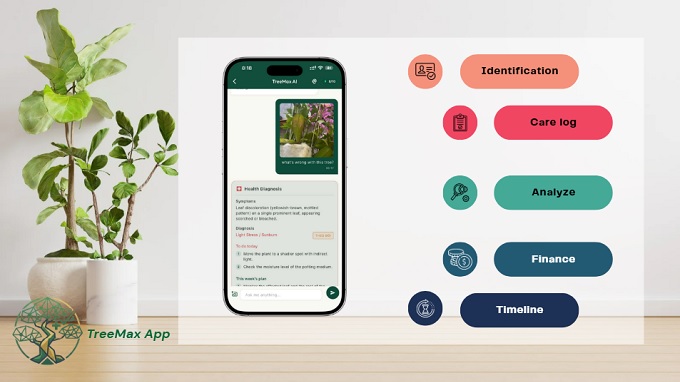
The fastest way to secure an identification is to use TreeMax. Open the app, point your camera at the plant, and let the Vision AI analyze the leaf structure, venation, and growth pattern. It cross-references millions of botanical data points to give you the exact scientific and common name instantly.
Once identified, TreeMax automatically saves the plant to your AI Garden Memory, instantly mapping out its native climate, preferred humidity, and light thresholds.
[Image: A close-up of a smartphone utilizing an AI scanner to instantly identify a wilting houseplant]Step 2: Triage — Decode the Leaf Symptoms
Now that you have a name, look closely at the damage. Your plant is speaking to you through its leaves. Here is how to decode its final words:
- Symptom: Soft, mushy yellow leaves starting at the base.
- The Verdict: Drowning. The roots are suffocating in stagnant water and beginning to rot.
- Emergency Action: Stop watering immediately. Pull the plant out of its pot. If the roots look black and slimy instead of firm and white, prune away the rot and repot in fresh, dry soil.
- Symptom: Crispy, brown leaf tips or edges.
- The Verdict: Extreme thirst or low humidity. This is incredibly common in air-conditioned apartments or during winter heating.
- Emergency Action: Give the plant a thorough soak. Trim away the dead, brown edges with clean scissors so the plant stops wasting energy trying to heal dead tissue.
- Symptom: Sudden leaf drop (green leaves falling off overnight).
- The Verdict: Environmental shock. Many popular trees, like the Fiddle Leaf Fig, hate being moved, subjected to cold drafts, or placed near AC vents.
- Emergency Action: Find a spot with bright, indirect sunlight, put it down, and leave it alone. Let it stabilize.
Step 3: Put Your Garden on Auto-Pilot
Once you’ve stabilized your patient, the goal is to make sure you never land in the emergency room again. Traditional gardening guides tell you to water your plants “once a week.” This is a myth. A plant’s water consumption changes daily based on cloud cover, indoor temperature, and seasonal shifts.
Instead of guessing, let AI handle the scheduling. TreeMax syncs with your local weather data. If it’s an unusually hot, dry week, the app will adjust your care prompts, reminding you to check on your moisture-loving plants. If it’s a rainy, humid stretch, the app tells you to hold off, protecting your garden from accidental overwatering.
Quick-Start Rescue Checklist
| If your plant is identified as a… | Do this immediately to save it: |
| Succulent / Cactus / Snake Plant | Move to the sunniest window. Do not water until the soil is completely dry to the bottom. |
| Pothos / Philodendron / Ivy | Clip off yellow leaves. Water thoroughly if the soil feels dry like dust. |
| Monstera / Ficus / Calathea | Move away from direct sun. Mist the air around it or place it on a wet pebble tray for humidity. |
Frequently Asked Questions (FAQ)
Q: Can a plant recover if all its leaves have fallen off?
A: Yes, potentially! Scratch the main stem gently with your fingernail. If the tissue underneath is still green and moist, the plant is alive. Cut back the dead branches and use the TreeMax AI Tree Doctor to monitor its soil conditions until new growth appears.
Q: Why does my new plant have sticky white fuzz on the stems?
A: That isn’t mold—it’s a pest called Mealybugs. They suck the sap out of your plants, killing them quickly. Isolate the plant from your other greenery immediately, dab the bugs with a cotton swab dipped in rubbing alcohol, and let TreeMax guide you through a full pest eradication protocol.
Don’t Let It Become A Memory
Every great gardener has a history of plants they accidentally lost before they learned the ropes. But with modern technology, you don’t have to learn through tragedy. You can get expert-level insights the second you bring a new plant home.
Name it, claim it, and save it.
[Download TreeMax on iOS or Android today] to identify your mystery plants instantly, budget your green expenses, and keep your indoor jungle perfectly healthy.
>> Also Read:
- Indoor Plant Identification Guide: Find Your Plant & Save It
- Best App for Plant ID and Garden Maintenance: Why TreeMax Stands Out
TreeMax App
